A 5 mm grid that measures 5 mm
No account · no upload
Paper type19
Notes & writing
Data & plotting
Planning
— mm
PNG at 300 DPI · SVG is vector, transparent · both export one sheet
Generated on your device · no upload, no signup
Settings
More settings
Prints a measured strip. If a ruler disagrees with it, your printer is scaling the page.
Preview · not to screen scale
1:1 detail · 62 × 40 mm
Drawn in real millimeters. Hold a ruler to the screen — if it disagrees, your display's reported DPI is wrong, not the PDF.
Printable staff paper, to exact spec
Blank manuscript paper: five-line staves down the page, each system closed with barlines.
The line gap is the measurement that governs everything else on staff paper, because notehead size, stem length and ledger line spacing all follow from it. Engraved music sits near 1.75mm. Handwriting wants more room than engraving, so the default here is 2mm, and 2.5mm is comfortable if you notate large.
Piano and keyboard music needs the grand staff instead.
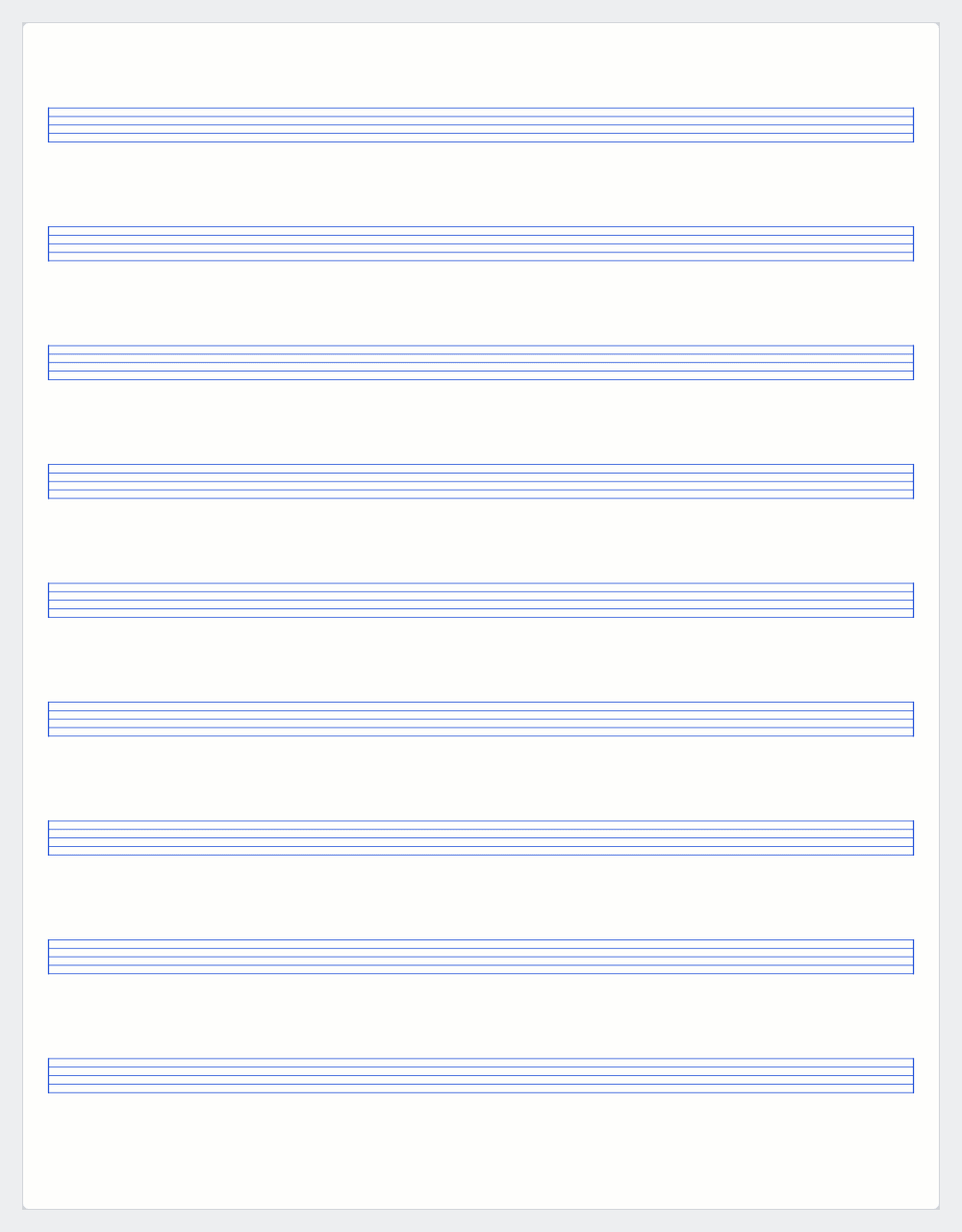
The line gap sets everything else
Every size in music notation is defined against the gap between staff lines. A notehead is one space wide and one space tall. A stem runs about three and a half spaces. Ledger lines continue at the same spacing.
Engravers describe staves by the total height of the five lines rather than the gap, a holdover from the rastrum used to rule staves by hand. About 7mm across the five lines is typical for a printed part, which is a 1.75mm gap. Full scores go smaller, vocal and beginner editions larger.
Handwriting needs more room than engraving
2mm is the default and suits most people with a fine pen or a sharp pencil. 2.5mm if you write large, work in pencil and erase a lot, or the music is dense with accidentals.
1.75mm is possible with a technical pen but not worth the trouble unless you are short of paper.
The gap also controls the space around the staff, where dynamics, hairpins, pedal marks, chord symbols and lyrics go. Widening the line gap opens that space too.
At 2mm a Letter or A4 page holds roughly 10 to 12 systems. At 2.5mm it is nearer 8 or 9.
What it does not print
Blank staves, with a barline closing each system. No clefs, no key or time signatures, no bar divisions inside the system, no instrument names.
Bar divisions are left out because bar length depends on the meter and on how much music is in each bar.
For piano and anything else needing two braced staves, use the grand staff page.
Frequently asked questions
What line gap?
2mm is standard. Wider if you write large or need room for ledger lines.
How many staves fit a page?
Around 10–12 on Letter at the default gap.
Piano?
Use grand staff paper — braced treble and bass pairs.