A 5 mm grid that measures 5 mm
No account · no upload
Paper type19
Notes & writing
Data & plotting
Planning
— mm
PNG at 300 DPI · SVG is vector, transparent · both export one sheet
Generated on your device · no upload, no signup
Settings
More settings
Prints a measured strip. If a ruler disagrees with it, your printer is scaling the page.
Preview · not to screen scale
1:1 detail · 62 × 40 mm
Drawn in real millimeters. Hold a ruler to the screen — if it disagrees, your display's reported DPI is wrong, not the PDF.
Printable hexagonal paper, to exact spec
A hexagon has six neighbors and all of them are the same distance away. A square has eight, and the four diagonal ones are 41% further off. That's the whole reason hex grids exist in wargaming and RPG maps: movement costs the same in every direction, so you don't need a rule to paper over diagonals being a bargain.
Hexagonal paper also turns up in organic chemistry, where the ring structures are literally hexagons, and in quilting and beadwork charting.
The size setting is the edge length of one hexagon. Width across the flats works out about 1.7× that, which is the number you want if you're sizing hexes around miniatures — 25mm bases need roughly a 15mm edge.
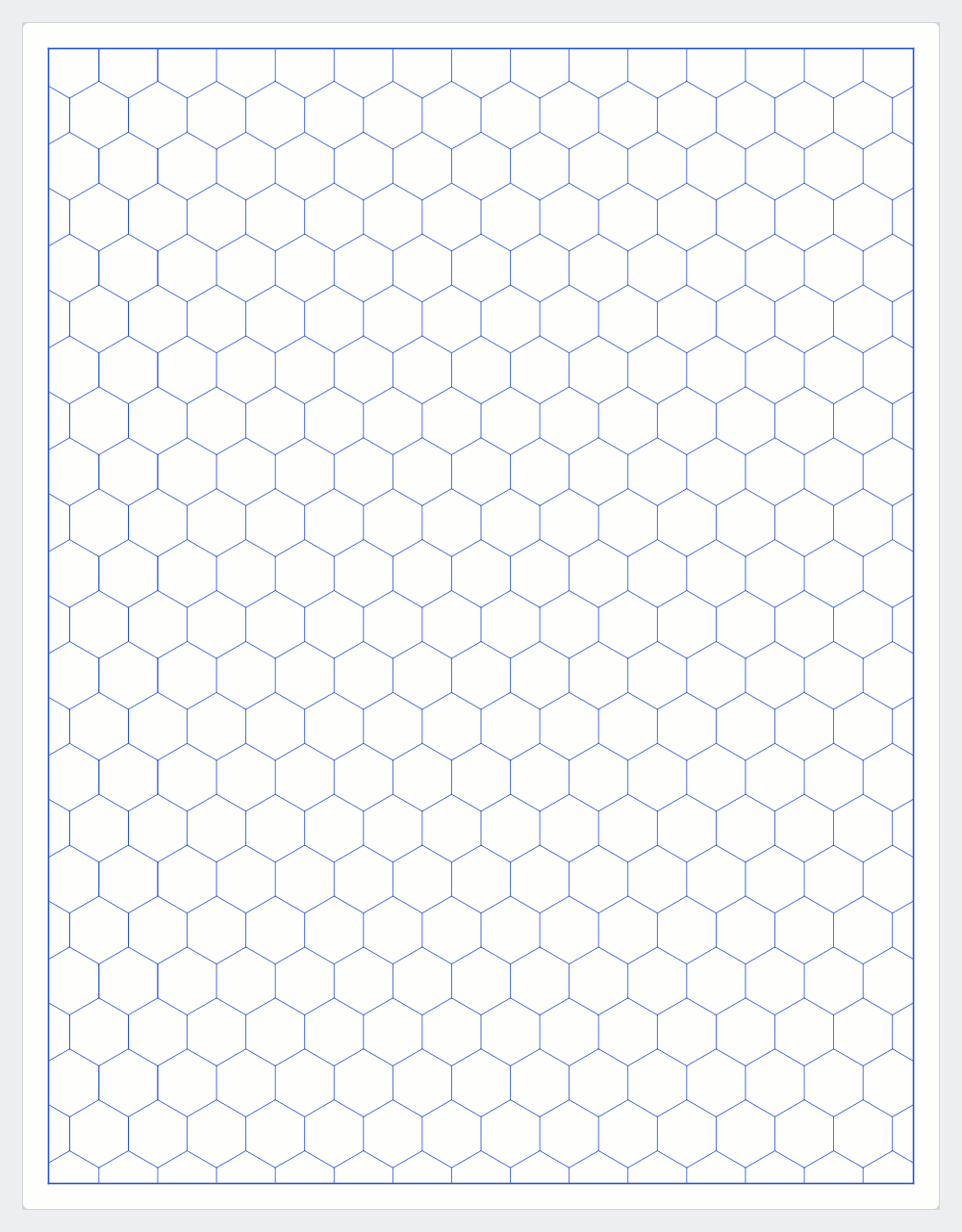
Pointy-top
The grid here is pointy-top: a vertex at the top, flat sides left and right, hexes stacking into offset vertical columns.
Pointy-top is the convention in most hex wargaming and in published RPG maps, where columns run down the page numbered 0101, 0102 and so on. Flat-top is more common in board game design.
For flat-top, print landscape and turn the sheet a quarter turn. The geometry is the same. The hexes are not numbered, because coordinate systems vary between rulesets.
Sizing for miniatures
The setting is the edge length. Width across the flats is the edge times the square root of 3, about 1.73. Width across the points is the edge times 2. On a pointy-top grid, height equals the across-flats figure.
For miniatures, across the flats is the number that matters, because that is the space a base sits in. A 25mm base wants about a 15mm edge, giving 26mm across the flats. 17 to 18mm leaves room so models do not touch. 32mm bases want a 20mm edge.
Overview and campaign maps work at 8 to 12mm, which fits enough hexes on a page to still write a terrain symbol in each.
Chemistry and craft use
Benzene rings and fused aromatic systems are hexagons, so hex paper draws them at a consistent size without a template. A 5 to 8mm edge suits chemistry, since a structure is several rings.
Hex grids also come up in English paper piecing, bead loom work and mosaic charting. To chart at true size, measure one physical hexagon across the flats and divide by 1.73 to get the edge length.
Frequently asked questions
Is hex size the edge or the width?
The edge. Width across the flats works out about 1.7× that.
What size for an RPG map?
15–25mm if you're placing miniatures on it, 8–12mm for overview maps. In inches that's about 5/8 to 1 for minis — there's a units toggle above the slider.
Pointy-top or flat-top?
Pointy-top.