A 5 mm grid that measures 5 mm
No account · no upload
Paper type19
Notes & writing
Data & plotting
Planning
— mm
PNG at 300 DPI · SVG is vector, transparent · both export one sheet
Generated on your device · no upload, no signup
Settings
More settings
Prints a measured strip. If a ruler disagrees with it, your printer is scaling the page.
Preview · not to screen scale
1:1 detail · 62 × 40 mm
Drawn in real millimeters. Hold a ruler to the screen — if it disagrees, your display's reported DPI is wrong, not the PDF.
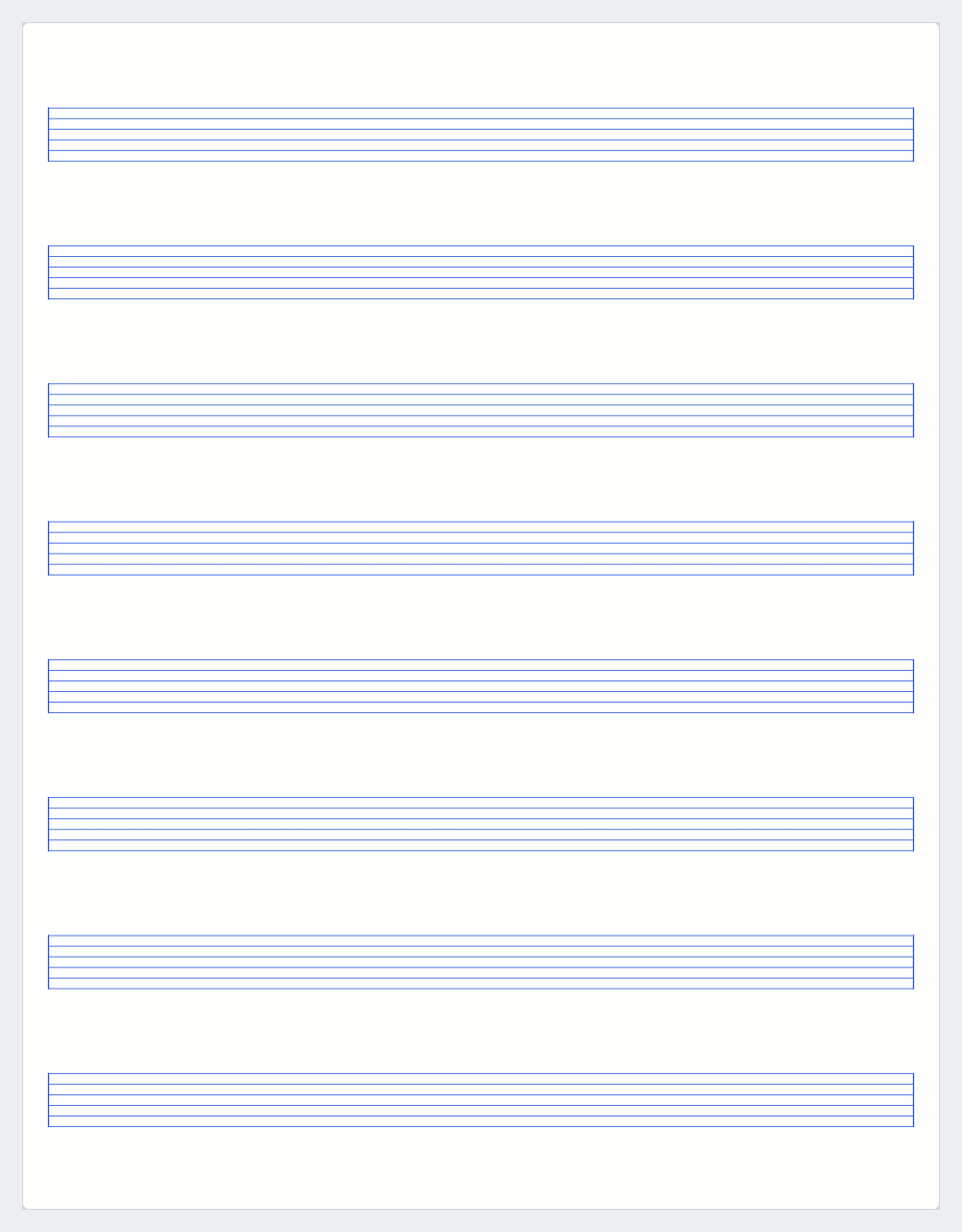
Printable guitar tab paper, to exact spec
Guitar tab paper is six lines, one per string, with fret numbers written on the lines. The advantage of tab over standard notation is that it tells you where to put your fingers rather than which pitch to produce — useful on an instrument where the same note is available in five places.
Its weakness is rhythm, which tab can't express at all. Most players write slashes or note stems above the stave, so leave yourself space up there when you pick the spacing.
2.5mm between strings is comfortable for handwritten fret numbers. Bass and ukulele are four-string instruments and have their own pages.
What tab records
A number on a line means press that string at that fret. Tab describes an action rather than a pitch.
That matters on guitar because the same note is available in several places and they do not sound the same. The open B string and the B at the seventh fret of the low E differ in tension, attack and sustain. Standard notation needs an added fingering to tell them apart.
Tab records nothing about time. No note duration, no rests, no ties. A piece you have not heard cannot be reconstructed from tab alone.
Writing rhythm
Most handwritten tab puts note stems and beams above the top line, aligned with the numbers below. There is no standard for it, but anyone who reads tab will follow it.
That needs vertical room above each stave. Check the preview for space between staves before printing a stack.
String spacing
2.5mm fits a two-digit fret number between the lines without touching either.
Go to 3mm if you write large, use a pen, or the music is full of bends and slides, which get written around the numbers. Narrower fits more on a page but makes double-digit frets tight.
Print one sheet and write a bar on it before printing more.
Markings, and which line is which
The common symbols: h for hammer-on, p for pull-off, slashes for slides, b for a bend with the target bracketed, r for release, a tilde for vibrato, x for a dead note, and PM with a dashed line for palm muting. Natural harmonics are usually bracketed or drawn with a diamond notehead.
The top line is the thin E and the bottom line is the low E. That is inverted from how the strings sit when you look down at the guitar, and it matches standard notation, where higher on the page means higher in pitch.
Frequently asked questions
What string spacing?
2.5mm for handwritten fret numbers. Wider if you notate a lot of bends and slides.
Bass or ukulele?
Both are four-string — there's a separate page for each.
Is there a notation staff above the tab?
No. Tab lines only.