A 5 mm grid that measures 5 mm
No account · no upload
Paper type19
Notes & writing
Data & plotting
Planning
— mm
PNG at 300 DPI · SVG is vector, transparent · both export one sheet
Generated on your device · no upload, no signup
Settings
More settings
Prints a measured strip. If a ruler disagrees with it, your printer is scaling the page.
Preview · not to screen scale
1:1 detail · 62 × 40 mm
Drawn in real millimeters. Hold a ruler to the screen — if it disagrees, your display's reported DPI is wrong, not the PDF.
Printable polar graph paper, to exact spec
Polar graph paper describes a point by direction and distance rather than by x and y, which is the natural way to handle anything that radiates, rotates, or points somewhere.
Rings mark distance, radial lines mark angle. Antenna radiation patterns, compass bearings, cam profiles, rose diagrams in geology, and an entire trigonometry syllabus of r = f(θ) curves all live on this grid — as does a good deal of mandala and radial design work, which cares about the symmetry and not the numbers.
Radials every 15° give the finest reading that stays legible; 30° or 45° leave a cleaner page to draw on. The four cardinal directions are always drawn heavier so you can orient at a glance.
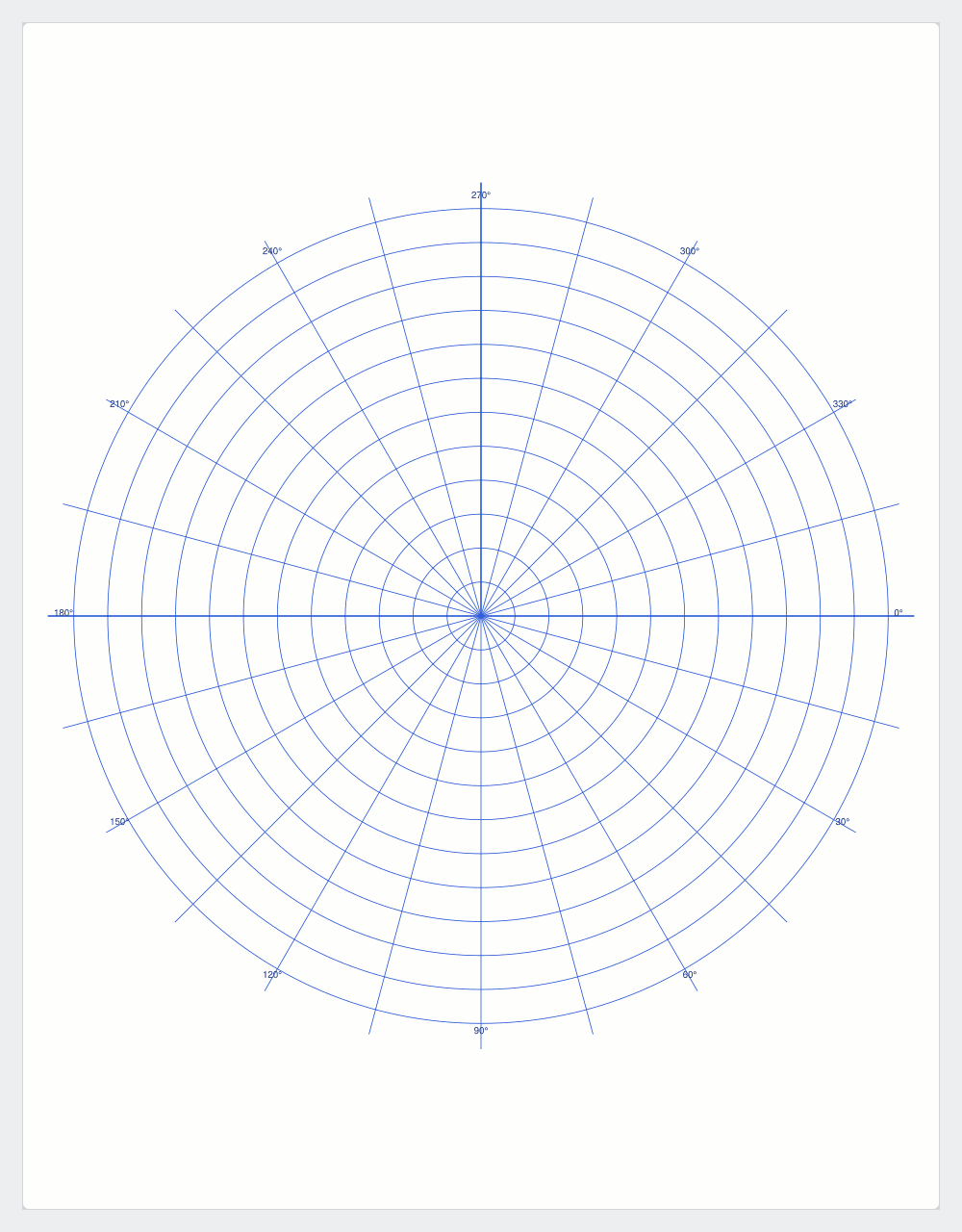
The rings are evenly spaced
Each ring is the same radial step as the last.
Antenna radiation patterns are normally drawn on a logarithmic radial scale in decibels, so a strong main lobe and weak sidelobes both show. On a linear grid the sidelobes collapse toward the center. You can convert to dB and assign a value per ring by hand, commonly 5 or 10dB, but the sheet will not do it for you.
Sound levels have the same problem. Anything with a wide dynamic range wants a log radial scale.
Angle increment
15 degrees gives 24 radials, close enough together to estimate to about 5 degrees between them. Use it for anything you read numbers off.
30 degrees gives 12 radials and a cleaner page to draw on. 45 degrees gives 8.
The four cardinals stay heavier at every increment.
Polar curves
r = a is a circle. r = a times theta is an Archimedean spiral with evenly spaced coils. r = a(1 + cos theta) is a cardioid, which is where the cardioid microphone pattern gets its name. r = a cos(n theta) is a rose with n petals when n is odd and 2n when n is even.
Plotting by hand, work around the angles the radials give you, mark the radius at each, and join them. 15 degrees gives 24 points, enough for anything but a tight spiral near the center.
Mandalas and radial design
For design work the requirement is enough radials to divide by the symmetry you want.
Six-fold and twelve-fold designs want 30 or 15 degrees. Eight-fold wants 45. Four-fold works with any of them.
Five-fold does not divide evenly into any available increment, since 72 is not a multiple of 15. Construct the five points with a compass and use the rings for radial spacing.
Frequently asked questions
What's it for?
Anything defined by angle and distance — trigonometry, antenna patterns, bearings, mandalas.
Which angle increment?
15° for technical work. 30° or 45° for a cleaner page.
Are the cardinal directions marked?
Yes, 0/90/180/270 are drawn heavier.