A 5 mm grid that measures 5 mm
No account · no upload
Paper type19
Notes & writing
Data & plotting
Planning
— mm
PNG at 300 DPI · SVG is vector, transparent · both export one sheet
Generated on your device · no upload, no signup
Settings
More settings
Prints a measured strip. If a ruler disagrees with it, your printer is scaling the page.
Preview · not to screen scale
1:1 detail · 62 × 40 mm
Drawn in real millimeters. Hold a ruler to the screen — if it disagrees, your display's reported DPI is wrong, not the PDF.
Printable isometric paper, to exact spec
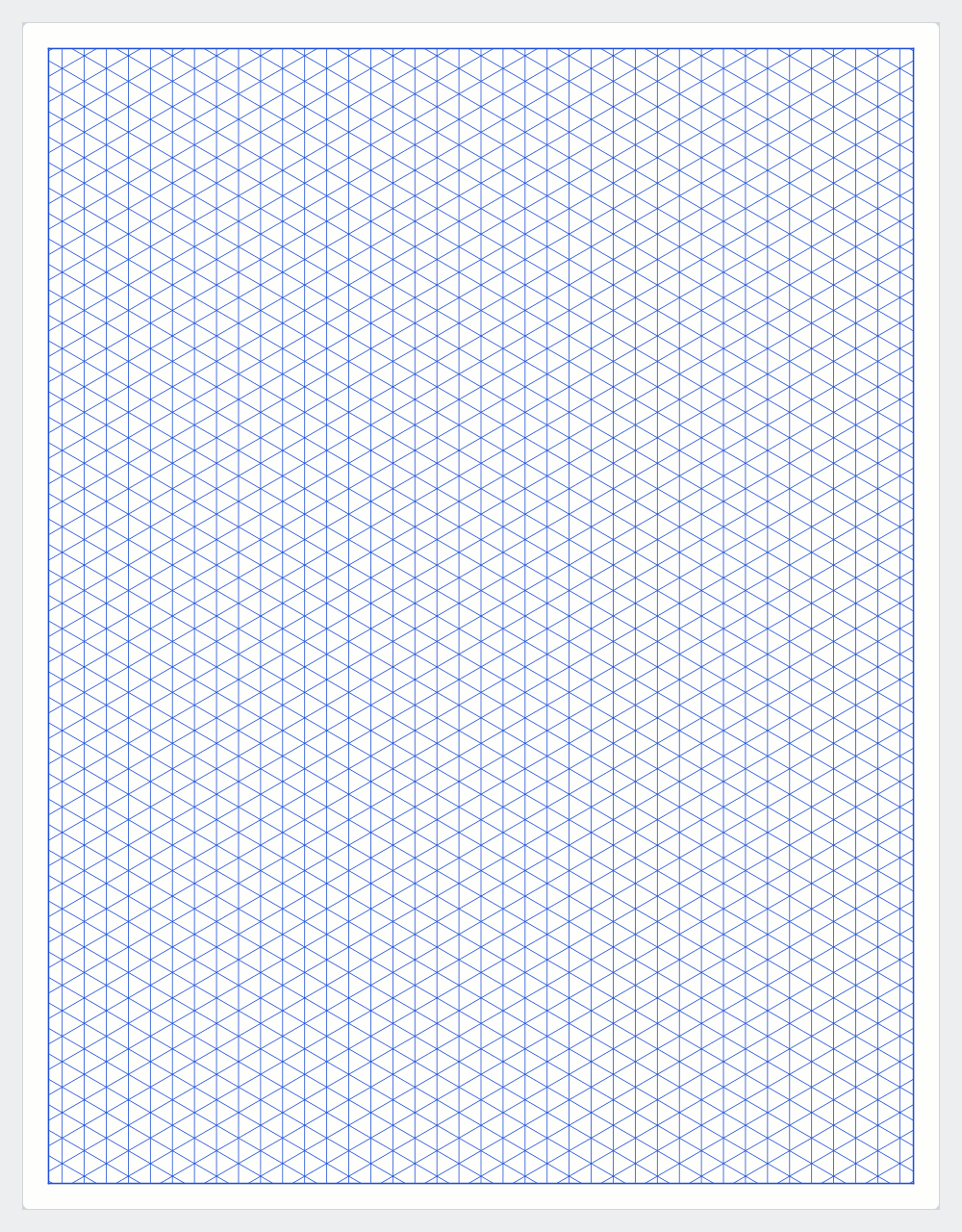
Isometric paper is a triangular grid: vertical lines, plus two sets running at 30° to the horizontal. Those three axes are what let you draw a cube that reads as a cube, with no perspective and no lines converging anywhere.
It has been the standard surface for pseudo-3D technical sketching for a long time, and it has had a second life in tabletop map design, where isometric rooms and terrain read more clearly than a flat overhead grid.
The spacing setting is the triangle side, meaning the distance between adjacent grid points. 6mm is a sensible starting point — finer for drafting, coarser for sketching.
The 30 degree angle
In an isometric projection the three axes sit 120 degrees apart. Projected onto the page, the two horizontal axes land at 30 degrees above the horizontal.
The useful property is that measurements hold along all three axes at the same scale. A 30mm edge is 30mm whether it runs up the page, back-left or back-right. Perspective drawing gives that up in exchange for looking the way a camera sees.
An isometric cube is ambiguous about depth. Nothing tells you which face is nearer, so a stack of cubes can appear to flip inside out, the same effect as a Necker cube. Shading resolves it.
What the spacing sets
The number is the distance between adjacent grid points along any axis, which is the side of one triangle. It is not the triangle's height, which is about 0.87 times the side.
6mm is a reasonable default. 4 to 5mm for drafting and detailed work, 8 to 10mm for sketching. Below about 3mm the three line sets merge into flat gray at normal weights.
Drawing on it
Pick a vertical line as the near corner and work outward along the two 30 degree axes. Box shapes then become counting.
Circles are harder. A circle in an isometric plane projects to an ellipse, and drawing one freehand between grid points takes practice. Isometric ellipse templates exist for this.
For tabletop maps, isometric shows stairs and elevation changes that an overhead grid cannot.
Frequently asked questions
What's it for?
Sketching 3D objects in proportion — technical drawing, product design, tabletop maps.
What triangle size?
6mm is a fair default. Smaller for detail, larger for quick sketching.
How is it different from graph paper?
Graph paper is a square grid. Isometric is triangles at 30°, which is what gives you depth.